

Real‑world asset (RWA) tokenization has moved beyond experimentation. Enterprises, real‑estate developers, and Shariah‑compliant fund managers now use white‑label infrastructure to unlock liquidity, reduce operational friction, and open access to new investor groups. In GCC‑aligned markets, stronger regulatory frameworks, registry‑linked systems, and growing interest in digital asset models have made tokenization far more practical for real business use cases.
Saudi Arabia has already completed its first tokenized title‑deed transaction under the Real Estate General Authority (REGA), and the Capital Markets Authority (CMA) has issued 68 experimental fintech permits by the end of Q2 2025, with 50 firms in its Fintech Lab and 36 already operational.
In this blog, we will explore about the white‑label RWA tokenization platform, RWA tokenization development companies, or white‑label tokenization platform development providers that can help you move beyond pilots and into a scalable, compliant model. Here, you will see how to deploy a white‑label RWA tokenization platform that aligns with enterprise‑grade, Shariah‑compliant, and institutionally‑ready demands without re‑building everything from scratch.
Understanding the tokenized real‑world assets platform concept
A white‑label RWA tokenization platform is a pre‑built, rebranded infrastructure that lets you issue, manage, and distribute tokenized real‑world assets under your own brand. Think of it as a back‑end engine for tokenization: you handle branding, governance, and investor relationships, while the platform provider supplies the issuance logic, compliance workflows, investor‑management tools, and multi‑chain connectivity. This is a full‑stack layer for real‑estate, funds, infrastructure, commodities, and Shariah‑compliant financial instruments—purpose‑built beyond basic crypto.
Where a fully custom‑built RWA tokenization stack demands deep blockchain engineering, ongoing security audits, and long‑term maintenance, a white‑label tokenization platform development model gives you a production‑ready architecture that has already solved many of these problems. You can still customize screens, workflows, and governance rules, but you avoid the 12–24‑month build‑time and multi‑year cost curve of building everything in‑house.
What Today’s Market Expects from Your Compliant Tokenization Platform
Modern RWA tokenization environments are judged on the full picture: how fast they issue tokens, and how compliant, secure, and investor‑friendly they are.
- A compliant tokenization platform must support region‑specific KYC/AML, investor‑cap rules, and clear audit trails.
- A Shariah compliance tokenization platform must embed profit‑sharing, risk‑sharing, and no‑interest‑based logic into the issuance and governance model.
- An institutional RWA tokenization setup must provide treasury‑style controls, operational reporting, and no‑surprise governance.
Platforms that focus on real estate tokenization platform use‑cases, for example, are expected to link token metadata to registry‑style data, automate rental‑income distribution, and support fractional asset tokenization for smaller investors.
Meanwhile, security token issuance platform models are built for tokenized closed‑end funds, private‑credit deals, and Sukuk‑style instruments, with strong governance, voting, and corporate‑action workflows. Your choice of RWA tokenization platform providers should reflect how tightly they map to your specific asset class and investor profile.
Core Capabilities Your White‑Label Platform Must Have
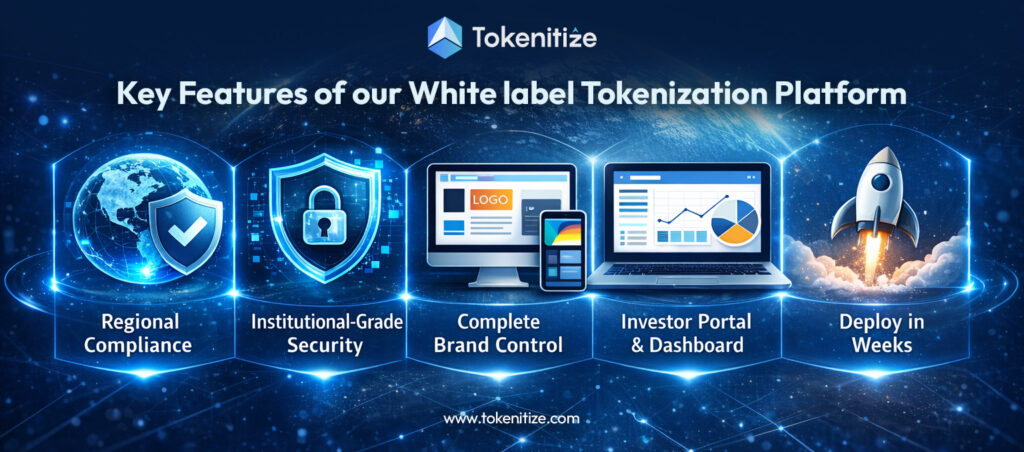
To stay competitive, your white‑label tokenization software should cover several key areas. You can use these as a checklist when evaluating RWA tokenization development companies:
Multi‑Chain, Standards‑Compliant Architecture
Today’s best white‑label RWA tokenization platform solutions are not locked to one chain. They support multiple blockchains (e.g., Ethereum, Polygon, and other enterprise‑grade networks) and standard‑based token models like ERC‑1400 security token and ERC‑3643 tokenization standards. By using these standards, you ensure your tokens are interoperable, auditable, and easier to plug into secondary markets and custody‑grade environments.
Compliance‑First Workflows
A compliant tokenization platform must bake compliance into the core from day one. That means:
- Built‑in KYC/AML workflows with investor‑tier segmentation.
- Investor‑cap rules based on geography, accreditation level, and Shariah‑eligibility.
- Audit‑ready logs, transaction monitoring, and role‑based permissions.
These features are essential when targeting markets like Saudi Arabia, where REGA‑style real‑estate tokenization infrastructures, CMA‑aligned frameworks, and SAMA‑style data‑sovereignty rules are already shaping expectations for where data sits, who accesses it, and how often it is reported.
Saudi regulations also require regulated entities to obtain approval before signing cloud‑contract commitments, reinforcing that data‑residency and infrastructure‑location decisions are part of compliance planning.
Fractional Asset Tokenization and Investor‑Side UX
Tokenizing a building is the starting point; the real design work lies in how investors interact with it. A strong white‑label tokenization platform development stack offers:
- Clear fractional asset tokenization dashboards so investors see token‑owned stakes, projected yields, and distribution history.
- Role‑based views for retail investors, qualified investors, and institutional partners.
- Tools for investor onboarding, KYC, subscriptions, and secondary‑market activities without forcing you to build everything from scratch.
Custody‑Ready and Operations‑Friendly Features
If your model is closer to banks, treasuries, or regulated entities, you need a white‑label tokenization platform development environment that:
- Integrates with institutional‑grade custody providers.
- Supports token operations, such as redemptions, buybacks, and corporate‑action handling.
- Provides operational reporting, reconciliation views, and governance‑change workflows.
Even if you are not building a bank‑style stack, these features help you scale safely and reduce the risk of operational gaps later.
How RWA Tokenization Platforms Differ by Use‑Case
You will notice that RWA tokenization platform providers tend to specialize by use‑case rather than being generic “token‑printers.” Understanding this helps you pick the right vendor for your goals.
Real‑Estate‑First Systems
Some platforms are built around real estate tokenization platform workflows. They focus on:
- Property onboarding, metadata linkage to registry‑style infrastructures, and income‑distribution logic.
- Tokenization platform for real estate use‑cases such as project‑finance tokens, rental‑income tokens, and fractional‑ownership‑style models.
These platforms shine when your primary asset class is real estate and your goal is to unlock liquidity while staying aligned with national‑scale real‑estate tokenization frameworks.
Securities‑Style, Marketplace‑Oriented Platforms
Other vendors offer white‑label digital‑asset marketplaces optimized for security token issuance platform models. These focus on:
- Tokenized closed‑end funds, private‑credit deals, and structured‑finance instruments.
- Investor‑management dashboards, secondary‑market order books, and governance‑style voting tools.
If you are building a more capital‑markets‑style product, this type of platform fits your model better than a pure real‑estate tokenization stack.
Developer‑ and Issuer‑Centric Platforms
A third category targets white‑label crypto platform builders and asset managers who want to move quickly but still retain control. These platforms:
- Offer fast‑deployment, branded tokenization environments with no‑code or low‑code issuance tools.
- Focus on flexibility over lock‑in, letting you design custom flows around RWA tokens, Shariah‑compliant structures, or multi‑asset portfolios.
They are ideal if you want to own your brand and governance but still stand on a tested, compliant backbone.
Government‑ and Registry‑Linked Platforms
Finally, there are sovereign‑scale stacks that plug directly into national registries and real‑estate tokenization infrastructures. These platforms:
- Are built for national‑scale real‑estate tokenization frameworks and registry‑linked metadata.
- Emphasize regulatory‑aligned, long‑term operation, often in coordination with ministries and regulators.
You may not need this level of infrastructure if you are starting with a niche product, but it is important to understand how your chosen RWA tokenization platform providers sit alongside these sovereign‑grade environments.
Evaluating best RWA tokenization companies in the ecosystem
Selecting a vendor means choosing a long‑term partner for your RWA tokenization development ecosystem. Here are the key questions you should ask.
Platform’s Primary Use‑Case
Is it built for real estate tokenization platform, security token issuance platform, or multi‑asset RWA platform models? Every vendor has a core strength, and that strength most often reveals itself in their primary use‑case. If your focus is real estate, pick a platform that has deep real estate tokenization platform experience. If your focus is Shariah‑compliant funds or Sukuk‑style instruments, look for Shariah compliance tokenization platform‑ready stacks.
Standards and Chains It Supports
Ask explicitly about ERC‑3643 tokenization, ERC‑1400 security token standards, and multi‑chain support. In a jurisdiction where the CMA now accepts security token‑based business models under its experimental framework, matching those standards with local‑style data‑sovereignty expectations becomes a clear competitive advantage for your platform provider.
A platform that treats these as first‑class citizens will give you far more flexibility than one that only supports proprietary token models or a single blockchain. Multi‑chain readiness also future‑proofs you against shifts in custody, regulatory tolerances, and investor‑preferences.
Shariah‑Ready and Compliance
A compliant tokenization platform must go beyond basic KYC. It should support tiered investor roles, geographic restrictions, and audit‑ready reporting. If Shariah‑compliance is part of your model, the platform should:
- Offer built‑in logic for profit‑sharing, risk‑sharing, and no‑interest‑based structures.
- Allow you to define Shariah‑certified governance rules and investor‑eligibility filters.
These features are especially important in markets like Saudi Arabia, where investors expect both Shariah‑alignment and institutional‑grade oversight.
Concept to Live Process Acceleration
Look at how quickly you can deploy a white‑label tokenization platform development stack. Some environments let you move from concept to live in weeks, while others require months of integration and testing. A fast‑deployment model, when done right, means you are leveraging pre‑built modules, tested workflows, and proven governance patterns, with quality built in from the start.
Data‑Sovereignty and Regulatory‑Alignments
Ask how the platform handles data‑residency, reporting, and integration with local‑style frameworks. In some jurisdictions, cloud‑based deployment must be located in‑country unless explicitly approved otherwise; a strong RWA tokenization platform providers stack will help you navigate this without forcing you into a one‑size‑fits‑all cloud model.
Brand Positioning in a Competitive RWA Market
You are entering a space where several platforms already exist, from real‑estate‑first, marketplace‑style, custody‑heavy, and sovereign‑infrastructure‑focused models. The key differentiator is not just features; it is fit‑for‑purpose and brand ownership.
A white‑label RWA tokenization platform like the one you are building gives you:
- Asset‑agnostic design: You can support real estate, funds, commodities, and Shariah‑compliant instruments without re‑building the core each time.
- Multi‑chain flexibility: You stay aligned with evolving custody, regulatory, and investor preferences.
- White‑label crypto platform branding: Your name, your UX, your governance, your risk‑profile.
Unlike some sovereign‑infrastructure‑heavy or marketplace‑only models, you are not locked into a single registry, custodian, or trading venue. You can plug into emerging national‑scale infrastructures, custody‑grade stacks, and marketplaces as needed, while keeping your brand front‑and‑center.
How To Deploy a White‑Label RWA Platform Without Re‑Inventing Everything
You already know how to set up a tokenization environment; now you need to think in terms of deployment and governance rather than just “how to build.”
Define Your Use‑Case and Asset Class
Start by deciding whether your primary use‑case is real estate tokenization platform, Shariah‑compliant Islamic‑finance tokens, or institutional‑style RWA securities. Each requires slightly different metadata, governance, and investor‑eligibility rules.
Select A White‑Label Tokenization Platform Development Partner
Choose a partner that supports multi‑chain, ERC‑3643 / ERC‑1400, Shariah‑compliance, and regulatory‑aligned workflows. Look for vendors that already have production‑ready customers, not just pilot‑only case studies.
Design Governance and Operational Rules
Focus on governance even before you issue the first token. Decide:
- Who can propose changes to token rules and who can approve them.
- How often you will distribute income, how you will handle corporate‑style actions, and how you will communicate with investors.
These rules turn your tokenized real‑world assets platform from a technical experiment into an operational product.
Start With A Focused Pilot
Begin with a single asset class (for example, a real estate tokenization platform for one project) and a clear investor‑pool. Use this pilot to test governance, compliance, and investor‑onboarding flows. After you prove the model works, you can expand to multi‑asset RWA ecosystems, Shariah‑compliant innovation, and institutional RWA tokenization.
How We Can Help: Tokenitize as Your RWA Partner
You now understand what a white‑label RWA tokenization platform should cover, how to evaluate RWA tokenization development companies, and how to design a deployment that aligns with real‑world‑asset, Shariah‑compliant, and institutionally‑ready expectations. The next step is to decide who will help you execute it.
At Tokenitize, you get more than just software: you get a white‑label crypto platform built specifically for real‑world asset tokenization and SME‑ to enterprise‑ready use‑cases. You are not limited to one asset class or one geography; the platform is designed to scale with your vision.
Faster Deployment with a Production-Ready Platform Stack
Instead of starting from scratch, you can use Tokenitize’s white‑label tokenization platform development stack as your base layer. You retain your brand, your UX, and your governance while standing on a production‑ready environment that already supports:
- Multi‑chain issuance and ERC‑1400‑style security‑token‑compatible patterns.
- Compliant tokenization platform workflows, including KYC/AML, investor‑tiering, and audit‑ready reporting.
- Fractional asset tokenization dashboards so investors can clearly see stakes, yields, and distribution history.
This lets you move from design to white‑label RWA tokenization platform deployment in a matter of weeks, not years, while keeping your brand front‑and‑center.
Shariah-Compliant and Institutional-Ready Platform Logic
If you are targeting markets where Shariah compliance tokenization platform design matters, Tokenitize helps you:
- Define Shariah‑aligned governance models for profit‑sharing, risk‑sharing, and no‑interest‑based structures.
- Build investor‑eligibility filters and investor‑tier rules that reflect local and institutional requirements.
- Design a tokenized real‑world assets platform that feels familiar to both traditional investors and crypto‑savvy users.
This is a flexible backbone that lets you embed your own compliance and governance logic in a way that still feels simple for your team and investors, fully customizable rather than a fixed template.
Infrastructure Layer Across Real Estate, Funds, and Multi-Asset Models
Whether your focus is:
- Real estate tokenization platform use‑cases (project‑finance tokens, rental‑income tokens, or fractional‑ownership models),
- Institutional RWA tokenization for private‑credit, infrastructure, or structured‑finance instruments, or
- Multi‑asset RWA ecosystems that combine real estate, commodities, and Shariah‑compliant funds,
Tokenitize helps you standardize your issuance and governance across asset classes without re‑building your stack each time. You can start with a focused pilot (for example, one tokenization platform for real estate project) and then expand into a broader ecosystem.
How To Get Started with Tokenitize
If you want to see how a white‑label RWA tokenization platform fits your specific use‑case, you can:
- Discuss your asset class, target investor profile, and Shariah‑compliance needs with our team.
- Walk through a tailored scope for your white‑label tokenization platform development stack, including timelines, feature priorities, and regulatory‑alignment considerations.
- Move quickly into a pilot‑ready environment that you can brand, customize, and scale as your user‑base and assets grow.
Tokenitize is built for organizations that want a white‑label crypto platform that is both flexible and enterprise‑ready—not a generic, one‑size‑fits‑all solution. Your brand, governance, and vision stay front‑and‑center, we build and deploy the infrastructure that supports them.
How to Turn RWA Tokenization from Trend into Strategy
A white‑label RWA tokenization platform is a strategic lever for liquidity, investor reach, and operational efficiency — one that extends well beyond a standard technology project. In markets like Saudi Arabia, where real estate tokenization platform infrastructures, Shariah‑compliant demands, and institutional‑grade expectations are aligning, you have a rare window to position your brand as a trusted, compliant, and innovative player in the RWA space.
By choosing a white‑label tokenization platform development partner that supports multi‑chain, ERC‑3643 tokenization, ERC‑1400 security token standards, Shariah compliance tokenization platform workflows, and fractional asset tokenization, you can move faster, stay compliant, and scale safely. You are building a bridge between traditional real‑world assets and a new generation of token‑savvy investors — and the platform is the infrastructure that makes it real.
Next Steps for Enterprises Exploring White-Label Tokenization
If you want to turn this thinking into an actionable plan, consider downloading a “RWA Tokenization Playbook for Enterprises” or a “Checklist for RWA Tokenization Development Companies: What to Ask Before Choosing a White‑Label Platform” from Tokenitize. This will help you evaluate RWA tokenization platform providers, refine your white‑label tokenization software requirements, and deploy a white‑label RWA tokenization platform that aligns with your enterprise‑grade, Shariah‑compliant, and institutionally‑ready goals.
FAQs
What is a white‑label RWA tokenization platform?
A white‑label RWA tokenization platform is a pre‑built, rebranded infrastructure that lets you issue, manage, and trade tokenized real‑world assets under your own brand. You can customize branding, governance, and investor‑side UX, while the platform provider handles underlying issuance logic, multi‑chain connectivity, and compliance workflows. This makes it ideal for enterprises, real‑estate developers, and Shariah‑compliant fund managers who want to deploy a compliant tokenization platform quickly without building everything from scratch.
What are white‑label tokenization development companies?
White‑label tokenization development companies are vendors that design and operate production‑ready tokenization stacks that you can license and rebrand as your own. These companies provide the core engine—issuance, compliance, investor‑management, and multi‑chain support—while you focus on asset strategy, investor relationships, and brand experience. They are especially useful if you want a white‑label RWA tokenization platform that aligns with enterprise‑grade, Shariah‑compliant, or institutionally‑ready demands.
What is RWA tokenization?
RWA tokenization converts real‑world assets like real estate, funds, infrastructure, or commodities into digital tokens on a blockchain. Each token represents a share of ownership, enabling fractional access, secondary‑market trading, and clearer transparency. This approach brings illiquid assets into more liquid, auditable digital markets and is often implemented via a tokenized real‑world assets platform.
What token standards are used for RWA tokenization?
For RWA tokenization, common standards include ERC‑20 for basic divisible tokens and purpose‑built security‑token standards like ERC‑1400 and ERC‑3643, which support investor‑eligibility rules, compliance‑ready issuance, and permissioned secondary‑market logic. Platforms built around these standards are often described as a white‑label security token issuance platform or a compliant tokenization platform.
Which is the best white‑label RWA tokenization companies?
The “best” white‑label RWA tokenization companies depend on your asset class, regulatory jurisdiction, and operational model. Leading providers typically offer: multi‑chain support, strong KYC/AML and compliance workflows, and tight integration with real‑estate tokenization platform or security‑token‑style patterns. For enterprise‑ready, Shariah‑compliant, or institutional RWA tokenization, look for vendors that explicitly support ERC‑1400 security token and ERC‑3643 tokenization standards.
White‑label vs custom tokenization platform — which is better?
A white‑label tokenization platform is usually better if you want to deploy a compliant tokenization platform faster and with lower cost and risk. You get a production‑ready architecture that already handles issuance, compliance, and multi‑chain operations, while you keep your brand and governance. A custom‑built platform suits large institutions that need deep internal control or bespoke integrations but comes with longer timelines and higher ongoing maintenance. For most enterprises and asset managers, a white‑label RWA tokenization platform offers the optimal balance of speed, compliance, and flexibility.
Which blockchain is best for RWA tokenization?
Ethereum is often considered the best‑supported blockchain for RWA tokenization because it hosts mature, widely adopted token standards like ERC‑1400 and ERC‑3643, strong custody integrations, and a large developer ecosystem. Layer‑2 and EVM‑compatible chains like Polygon are popular when you need lower‑cost transactions while staying close to Ethereum’s security and compliance landscape. The “best” chain for your RWA tokenization use‑case usually depends on your regulatory stance, data‑sovereignty needs, and investor‑preference for certain blockchains.
Which tokenization platform is best for real estate?
The best tokenization platform for real estate is one built as a real estate tokenization platform or tokenization platform for real estate, with native support for property metadata, rental‑income distribution, and fractional‑ownership models. Such platforms typically link token records to registry‑style data, embed KYC/AML and investor‑tiering workflows, and support multi‑chain, compliant tokenization standards. For GCC‑aligned markets with Shariah‑compliance awareness, an ideal setup is a Shariah‑compliance tokenization platform that still follows real‑estate‑first design patterns.

Tanvi Rana is an RWA tokenization strategist and writer specializing in blockchain-based asset tokenization, Shariah-compliant finance, and real-world asset markets. With deep expertise across tokenized real estate, commodities, Islamic finance instruments, and regulatory frameworks spanning the GCC, she translates complex tokenization infrastructure and compliance landscapes into clear, actionable content. Tanvi has covered everything from smart contract architecture to secondary marketplace dynamics and multi-chain deployment. Her work bridges institutional finance and blockchain innovation, helping businesses and investors navigate the rapidly evolving world of asset tokenization, from fractional ownership to full-scale platform launches.